Employers
See what our clients are saying about SalesFirst Recruiting
-
![Client review]()
Ryan, VP of Sales
“I have been working with SalesFirst for years, and plan to continue to for years to come. I’m always impressed with their ability to understand my unique needs and deliver the candidates that fit, but perhaps more important than any of that… they are always very good about communicating throughout every stage of the hiring process."
-
![Client Review]()
Ted, CEO
“I partnered with SalesFirst to hire a Vice President of Sales. Following initial introduction to SalesFirst through Carlee Myers, Mark Herman became my point of contact for the search. Mark and the SalesFirst team did an excellent job managing our expectations throughout the recruiting process including maintaining a strong candidate pipeline, facilitating a prescriptive interview process, and aligning with our total compensation objective for the role. Most importantly, the SalesFirst team identified the ideal executive for our business within the requested timeframe in a difficult hiring environment. Following this positive experience, I look forward to working with SalesFirst on commercial talent acquisition needs in the future.”
-
![Client Review]()
Andy, Director of Sales
“I had a great experience working with SalesFirst Recruiting. From start to finish, they were extremely professional. The two people I worked with Carlee and Kelly went above and beyond to meet our needs. They found quality candidates at a quick pace, and I found their screening process to be very thorough. Also I want to point out that I always felt like we were working as a team. I would absolutely work with them again!”
-
![Client Review]()
Rich, Director of Sales
“SalesFirst and Kelly have been amazing to work with! As a hiring manager having prompt & clear communication is such a valuable aspect in a recruiting partnership. We can always trust the organization of all the moving pieces are in order and that if a gentle nudge is needed to move something forward we'll hear. It takes another thing off our plate and allows us to focus on candidates, their quality, and ultimately our team. In addition, they are great about ensuring we are spending time on the candidates most qualified and initially screening out those that may not. I was recruited by SF for a role as a candidate and have the unique perspective of working with them on both sides of the business. My experience was top notch for both, and I continue to value the relationship now using them as our recruiting source as another way to give back for what ultimately has me on a career trajectory with a leader I would otherwise not have found.”
-
![Client Review]()
Nate, Divisional Director
“I have been working with SalesFirst for over 10 years and there is no better organization to partner with. SalesFirst Professionals know my business and the expectations we have for any prospective employees. Great People who engage with clients on a relational level to understand their needs for the long term.”
-
![SalesFirst Client]()
Christopher, CEO
SalesFirst provided exactly what I was looking for in a recruiting partner. I was struggling to find the right fit for a key sales leadership position and decided to get 3rd party help. SalesFirst was very easy to work with right from the start with great communication, discovery process for what we needed, and a simple contract process. We saw great candidates quickly and we're very excited about our new hire.
-
![SalesFirst Client]()
Russ, VP of Sales
I have used SalesFirst for nearly 10 years......What else needs to be said?
-
![SalesFirst Client Review]()
Gus, VP Operations
SalesFirst helped us find two excellent hires and multiple qualified and interesting applicants. Mark and Carlee made a difference in the ease and success of our hiring process. Thank you!
-
![SalesFirst Recruiting Client]()
Kimberlee, Sales Manager
We love working w/Kelly & Carlee. These ladies vet their candidates really well and have found us talented individuals! So easy to work with & great communication!
-
![Employer Review]()
Marcy, VP North America
It has been a pleasure working with SalesFirst Recruiting. They sourced several excellent quality candidates for us. In our discussions it really felt like our recruiting team understood our unique set of requirements, which made the experience very streamlined. Would absolutely recommend them!
-
![SalesFirst Recruiting Client Reviews]()
Will, Director of Global Sales Development
Amy is very easy to work with and always responsive. Quickly after I got in contact with them they already had multiple qualified candidates lined up for me to speak to. We will continue to go back to them for new talent.
-
![Salesfirst Recruiting Client]()
Luisa, President
“It was a pleasure to work with Madeline. She is attentive, caring, and intuitive and never rushed me through the process. She is a gem.”
-
![SalesFirst Recruiting Client]()
Paul, Director of Business Development
Chandler has been excellent to work with every step of the way. She sources amazing candidates, she is very responsive and I'm looking forward to working with her on more candidates in the future.
-
![SalesFirst Client]()
Paige, HR Leader
Partnering with SalesFirst—and especially Amy Schwartz—has been a game-changer in our recruitment strategy. After nearly a year of working solo to fill Commercial Sales Manager roles nationwide, Amy helped us place five strong hires in just a few months. She's responsive, thoughtful, and consistently brings high-quality candidates who align with both our needs and culture. The experience has far exceeded expectations, and I’d recommend Amy to any team looking to hire with confidence and care.
-
![SalesFirst Client Review]()
Barbara, HR Director
Madeline is an exceptional recruitment professional and leader. She takes time to gain a comprehensive insight from the employer about the company culture, best-aligned candidate profile, and key nuances for the search, to identify stand out candidates for each role.
-
![SalesFirst Recruiting Client]()
Martin, CEO
We were very satisfied with the support provided in filling a position in our internal sales team. The process was smooth, professional, and tailored to our needs. The candidate is a great fit, and we truly appreciate the excellent service.
-
![SalesFirst Client]()
Adam, Operations Manager
“Amy and her team did a fantastic job sourcing a candidate for me. Salesfirst was on top of all of my requests and was a pleasure to work with.”

The Team Behind Your Search
SalesFirst Recruiting was founded in 2011 by Adam Morris. Dan Morris joined the company in 2012 and became a Partner in 2017. Since then, the company has helped employers across the country hire customer-facing professionals through a structured, technology-enabled recruiting process.
Today, we're headquartered in Tigard, Oregon, with additional offices in Arizona and Colorado. We also have remote employees living across the United States, allowing us to support employers nationwide through Direct Hire, Contract Staffing, Temp-to-Hire, and Recruiting Consulting services.
We specialize in the people who drive revenue and strengthen customer relationships. From Account Executives, Outside Sales Representatives, and SDRs to Sales Engineers, Customer Success professionals, Sales Leaders, and revenue-focused marketers, these are the roles we recruit every day.

Access To Nationwide Talent
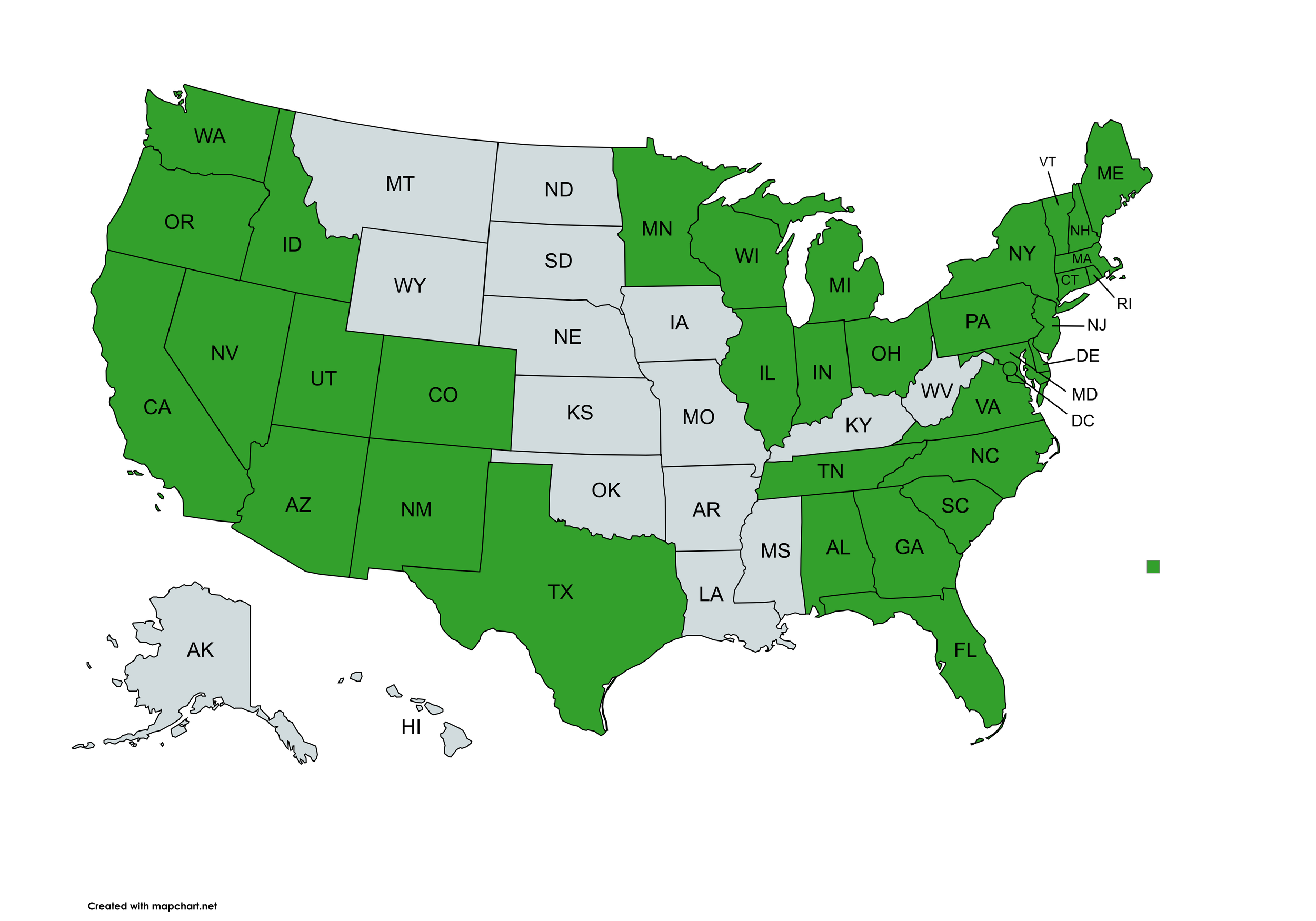
We recruit nationwide, and our team is spread across the country. There isn't a state that's inherently easier or harder for us to recruit. We simply go where the talent is. The map to the left highlights the states where we've completed the most searches and developed the deepest market knowledge, but we regularly recruit across all 50 states.
Customer-Facing Talent
SalesFirst specializes in customer-facing roles.
If the person you're hiring interacts with customers, prospects, partners, or key accounts, there's a good chance we can help. These are the positions we recruit every day, and they're the conversations we understand best.
That includes individual contributors, sales leaders, customer success professionals, account managers, business development representatives, marketing professionals who support revenue growth, and executives responsible for leading customer-facing organizations.
We've built our recruiting process around understanding how these roles create value, what success looks like, and how to identify the people who consistently perform at a high level.
-
Chief Executive Officer
President
Chief Revenue Officer
Chief Marketing Officer
Chief People Officer
General Manager / Vice President
-
Vice President of Sales
Director of Sales
Sales Manager
Account Executive
Account Manager
Sales Consultant
Business Development Representative (BDR / SDR)
Territory Sales Manager
Outside Sales Representative
Sales Operations Specialist
Sales Coordinator
Sales Administrator
Sales Enablement Manager
Sales Analyst
Sales Support Specialist
Sales Trainer
Revenue Operations Manager
CRM Manager
-
Vice President of Marketing
Director of Marketing
Marketing Manager
Marketing Specialist
Digital Marketing Manager
Content Marketing Manager
Social Media Manager
SEO Manager
Email Marketing Specialist
Product Marketing Manager
Marketing Communications Manager
Marketing Coordinator
Marketing Analyst
Marketing Operations Specialist
Marketing Assistant
Marketing Automation Specialist
Marketing Project Manager
Content Creator
Graphic Designer
Copywriter
-
HR Manager
HR Coordinator
HR Generalist
HR Specialist
HR Director
Chief Human Resources Officer (CHRO)
HR Business Partner
Employee Relations Manager
Compensation and Benefits Manager
Training and Development Manager
Talent Acquisition Manager
Recruiter
Talent Acquisition Specialist
Recruiting Coordinator
VP of Talent Acquisition
The Process
Your hiring decisions deserve consistency.
Every search follows the same proven process because every step serves a purpose. Over the years, we've refined our approach, removed unnecessary work, and strengthened the parts that consistently lead to better hiring decisions.
The result is a structured recruiting process that helps you evaluate candidates with greater confidence and make better hiring decisions.
-
Every successful search starts with a deep dive. We spend about 45 minutes learning about your business, your team, and the role you're hiring. We review your website, job description, and any documents you share. We ask about your customers, your sales process, your culture, and the people who have succeeded in the role before.
We learn how your business generates revenue, where this role fits within your organization, what success looks like, and the challenges the new hire will need to solve.
We also define your ideal candidate in detail. That includes the right industry experience, sales background, customer profile, products sold, deal size, sales cycle, geography, compensation, leadership style, and the companies where top performers are most likely to be found.
Along the way, we identify the qualifications that are essential, the experience that's preferred, and the traits that predict long-term success. Every detail becomes part of the search strategy.
This also gives you confidence that we're representing your opportunity accurately. From the first outreach message to the final interview, every interaction is built on a thorough understanding of your business and the people who succeed in it.
-
After the intake, we take everything we've learned and reduce it to a single statement.
It's a simple description of your ideal candidate, written in plain English.
When you read it, you should immediately recognize the person you're trying to hire. It captures the experience, mindset, sales background, industry knowledge, and personal qualities that matter most. It captures the essence of the role without getting buried in the details.
That statement becomes the foundation for the search. It guides our sourcing strategy, the outreach we write, the job description we publish, the scorecard we build, and the conversations we have with candidates.
Example
We're looking for someone who enjoys building relationships with manufacturers, is comfortable creating opportunities from scratch, and has a history of earning long-term customers through technical knowledge and follow-through. They're probably working for an industrial supplier or equipment manufacturer today, have built their own territory, and are ready for a bigger opportunity with more responsibility.
Once we can describe the person this clearly, the search becomes real. We know who we're looking for, the types of companies they're likely to work for, the experience they've probably built, and what will resonate with them.
People like this exist, and they're succeeding somewhere today. Our job is to go find them.
-
The statement we create during the intake defines who we're looking for, and this candidate scorecard defines how we'll evaluate them.
Before recruiting begins, we turn everything we learned during the intake into a structured evaluation framework. Every hiring priority, success factor, and requirement is translated into measurable questions that every candidate is evaluated against.
Some of those questions never change. We always evaluate career progression, promotion history, industry experience, functional experience, and employment stability because they provide important context about a candidate's career. The rest of the scorecard is built specifically for your search. It reflects the experience, sales motion, customers, products, technical knowledge, leadership traits, and other qualifications that define success in your organization.
Every candidate is evaluated against the same criteria. We only present candidates who score well against the scorecard we've built together. That means your interview process isn't spent determining whether someone is qualified. It's spent determining whether they're the right person to join your team.
We evaluate experience, qualifications, and fit for the role.
You decide whether they're the right fit for your culture, leadership team, and organization.
-
Every search includes two candidate strategies: one designed to identify passive candidates and another to attract active job seekers.
The majority of our placements come from traditional headhunting. Since we began tracking our results, between 88% and 93% of our hires have come from directly recruiting candidates who weren't actively looking for a new opportunity.
Using the candidate blueprint we've created, we identify the companies where these professionals are likely to work and reach out directly through phone calls, email, LinkedIn InMail, text messaging where legally permitted, and other personalized outreach. We also use LinkedIn Recruiter, Loxo, and premium sales intelligence platforms to identify candidates, verify contact information, and expand the reach of every search.
At the same time, we make your opportunity easy to find.
We write a compelling public-facing job description and distribute it across the SalesFirst job board, LinkedIn, Indeed, Glassdoor, ZipRecruiter, SimplyHired, Talentify, and other job networks. We also ensure the position is indexed by Google so qualified professionals searching online can find it.
Together, these two strategies allow us to engage the people actively looking for a new opportunity while directly recruiting the much larger group of professionals who are succeeding somewhere else today.
-
Finding qualified candidates is only the beginning. Before anyone is presented to your team, they move through a structured screening process designed to validate experience, uncover strengths, and identify potential concerns.
Every candidate completes:
A recruiter video interview to review their career history, sales performance, quotas, KPIs, and overall background.
The Core Value Index assessment to better understand personality, motivators, communication style, and behavioral strengths.
After the interview, our AI-assisted workflow reviews the interview notes, Core Value Index results, and recruiter observations to identify missing information, surface inconsistencies, and highlight areas that deserve additional attention before a hiring recommendation is made.
Finally, the assigned Account Manager reviews the complete candidate file, validates the evaluation, and confirms the candidate aligns with the role before they're presented to your team.
By the time you receive a candidate, they've been reviewed through multiple layers of evaluation. Our goal is simple: present fewer candidates, with greater confidence that they belong in your interview process.
Why SalesFirst Recruiting?
For well over a decade, prospective clients have asked us the same question: "Why SalesFirst?"
It's a difficult question to answer because anyone can make claims about service, technology, or results.
We've found it's better to show you the standards we've set for ourselves and the principles we've built the company around. Some are supported by measurable proof. Others reflect the expectations we hold ourselves to every day. Together, they explain how we think, how we recruit, and why clients continue to trust SalesFirst with their hiring.
-
Tenure shows that something is working. When recruiters stay with a company, it usually means the systems are proven, the leadership is steady, and the mission is clear.
People do not stick around in broken environments. They stay when the expectations make sense and the work has purpose.
A firm that retains its team year after year is showing you that it operates with structure, clarity, and trust.
-
Fancy websites mean nothing. It takes money to create a beautiful website and a polished brand. But great design does not deliver hires.
Recruiting outcomes come from systems. Firms need sourcing workflows, structured interviews, internal documentation, and quality controls that hold up across searches. These systems are built slowly, and they take training, repetition, and leadership that values precision.
A recruiting firm with real structure will not need flash. You will see it in how they run the process, how quickly they deliver, and how rarely they miss.
Good marketing is easy to spot. Good operations are not. Look deeper.
-
Well-built recruiting systems are not meant to shift with every request. They are the result of years of refinement, internal training, and real-world application. When a firm hesitates to change its process, it is often because that process already performs at a high level. Changing one part can compromise the whole.
A recruiter’s job is to deliver quality. That requires structure, repeatability, and boundaries. Some flexibility is useful, but too much can lower the bar.
If a firm holds the line on its process, it likely knows where quality comes from.
-
Strong recruiting firms are built on clear expectations and internal accountability. They put time into training, coaching, documentation, and feedback.
The work is too complex to be left to personality. Good recruiters follow structure. They prepare. They review each other’s work. They focus on detail.
Culture takes shape when teams are held to consistent standards. It does not rely on charm or enthusiasm. It relies on process and trust.
When you evaluate a firm, ask how they train their people and how they maintain consistency. That will tell you what kind of culture they’ve built.
-
Recruiting takes ongoing attention. Because the market is always changing, the best firms adjust their methods over time. They update their interview questions. They improve the way they communicate with clients. They tighten each step of the process when they see room to improve.
You will not see massive changes every quarter. You will see small updates that make the work cleaner and the results stronger.
Firms that stay sharp are always reviewing how they operate. They do not settle, and they do not stand still.
-
SalesFirst Recruiting leads with expert recruiters, but behind every search is an extremely powerful tech stack.
Technology should make people better at their jobs. In recruiting, it should help teams move faster, reduce blind spots, and keep things organized.
It cannot replace good judgment or interviews, or instinct. But it should support those things. The right tech setup allows recruiters to spend more time on the conversations and decisions that matter, and it clears space so they can do real work engaging candidates and clients.
Strong firms embrace technology and build their tools around people.
-
Strong recruiting results come from deep focus. When a firm stays in one lane, it builds sharper tools, stronger networks, and better instincts.
Specialization allows teams to notice details others miss. It shapes the way interviews are run, how candidates are prepared, and how feedback is applied.
Generalist firms may cover more ground, but focused firms know their space inside and out. That depth leads to better matches and faster outcomes.
Expertise is earned through repetition. Great firms stay close to what they know and keep getting better at it.
-
We are a high-performing firm of 13–20 professionals. Our size allows us to move quickly, stay aligned, and adapt to your specific hiring needs without layers of red tape. Every client receives focused attention from a team that delivers with urgency and care.
-
-
We integrate the Core Values Index (CVI) into our hiring process. It’s a proven psychometric tool we provide at no cost to clients & candidates. We offer both the scores and practical insight into the strengths, risks, and workplace tendencies associated with each CVI profile to help your team make hiring decisions with confidence and clarity.